
Fayette County Release Date Meanings
Tennessee corrections records use several dates that answer different questions. Release eligibility is the earliest statutory point at which parole consideration may occur. A parole hearing date is a scheduled review. A grant is a favorable Board of Parole decision, but TDOC states that release waits for approval of the release plan. Actual release occurs only after the required checks and custody handoff are complete.
Sentence expiration is the end of the imposed sentence calculation. It can be later than parole eligibility and later than physical release to parole. TDOC Policy 511.03 separately identifies Sentence Expires, Release Eligibility, Safety Valve Date, Max Sentence, and Date of Release on its release-authorization process. Those labels must not be collapsed into one date.
A pretrial person at Fayette County Jail has not yet received a sentence computation for that pending matter. Bond, dismissal, acquittal, a release order, or later judgment can change the custody path. Even a court order may not state the moment jail processing ended or show a separate hold. Ask both the court and jail when those facts matter.
Find a Fayette County Release Date
Begin with the last confirmed custodian. The Fayette County Jail and TDOC maintain different records. A person held only on a county pretrial matter may not appear in TDOC FOIL. Someone who left the county jail for TDOC may appear as incarcerated in FOIL, which shows transfer rather than community release.
- Check the Fayette County Jail source if the person was last held locally. A current listing means release is not yet confirmed.
- Call Booking at (901) 465-5247 for the jail computation or release information. Ask which date and legal authority control the local sentence.
- Request the sentencing judgment and later orders from Fayette Circuit and General Sessions Court. Check time-served credit and whether sentences run together or one after another.
- For a Tennessee felony sentence, search TDOC FOIL by TOMIS or State ID when possible, or use name and aliases.
- Read the exact label beside each future or past date. If the value is absent or unclear, request the sentence computation or release authorization from TDOC records.
The official FOIL form illustrates the fields available for matching a person. Open the live FOIL search to see its current wording.
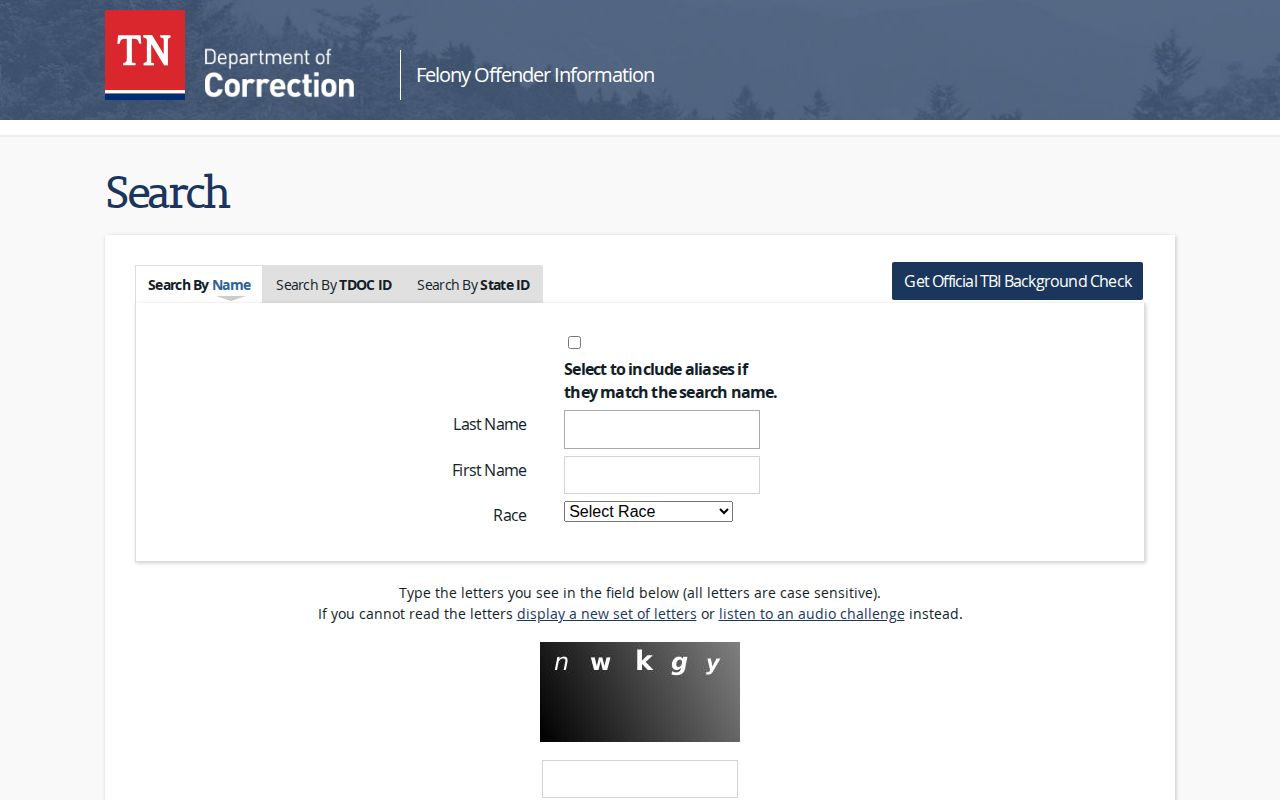
The form supports name and unique-identifier searches, but the resulting detail must be read with the offender's judgment and current TDOC calculation.
The TDOC FOIL description says the service covers felony offenders currently or formerly in custody or supervision. Results may include photo, status, location, offense, sentence information, parole-hearing status, and release information. “May include” is not a promise that every record has a projected date.
Note: Record the search date because credits, orders, custody status, and public display fields may change later.
Fayette County 85 Percent Limits
Tennessee does not have a sound universal rule that every person serves 85 percent. The offense date, offense, statute, judgment, sentence range, and credit history all matter. Public Chapter 988 created separate 100-percent and 85-percent categories for covered offenses committed on or after July 1, 2022. Applying that law from a charge label alone can yield the wrong date.
The official legislative summary places offenses such as attempted first-degree murder, second-degree murder, intoxication vehicular homicide, especially aggravated kidnapping, especially aggravated robbery, carjacking, and especially aggravated burglary in the 100-percent group. Credits may affect classification or privileges for that group but do not reduce the court-imposed term under this chapter's rule.
The 85-percent category includes listed offenses such as certain aggravated assaults, voluntary manslaughter, several homicide offenses, aggravated kidnapping, aggravated robbery, aggravated burglary, aggravated arson, firearm use during a dangerous felony, and qualifying repeat serious drug offenses. Qualifying program credits may advance parole eligibility by no more than 15 percent under that scheme. This means at least 85 percent in confinement and up to 15 percent on parole, when the rule applies. It does not erase the balance of the sentence.
For specified offense dates from July 1, 1995 through June 30, 2022, a different 100-percent-less-credits framework can apply, with credits capped at a 15-percent reduction for covered offenses. Some sexual-offense provisions differ. The current statutory subsection and the judgment control. Public Chapter 988 should not be applied backward to an earlier offense.
Fayette County Sentence Credit Rules
Tenn. Code Ann. § 40-35-501 governs major parts of release eligibility, while § 41-21-236 addresses sentence-reduction credits. Offense-specific statutes can add rules. Credits may be earned, forfeited, restored, or limited, depending on the governing law and record. No reliable date comes from multiplying the sentence by a single percentage.
A county sentence needs the underlying judgment and the jail's computation. Pretrial jail credit, the effective sentence date, multiple counts, and concurrent or consecutive terms can alter the result. Concurrent sentences run at the same time. Consecutive sentences run one after another. TDOC may calculate some felony sentences served locally, but FOIL is not guaranteed to display every Fayette County-only confinement.
- Release eligibility
- The first statutory point at which parole consideration may be possible.
- Parole grant
- A favorable decision that still requires release-plan approval and final processing.
- Sentence expiration
- The calculated end of the sentence, distinct from release to community supervision.
- Actual release
- The completed custody event after all checks, holds, and handoff steps.
- Safety Valve Date
- A separate TDOC release-authorization field that must be read under its governing rule.
Never calculate from the arrest date alone. Arrest can precede the effective sentence, and jail credit does not make every day equivalent under every statute. The exact computation belongs to the jail or TDOC, supported by the court record.
Release information can also remain incomplete on a public result. When FOIL shows no future value, that does not authorize a home calculation. Ask TDOC for the sentence computation and name the fields needed. For a Fayette County sentence, ask Booking which office maintains the computation, then compare it with the certified judgment and any later order awarding credit or changing the sentence.
Why Fayette County Dates Change
A projected release date represents the known calculation at one point in time. Later events can move the practical outcome or prevent community release on that day. Some events alter the sentence math. Others leave the date in place but change where custody goes next.
| Factor | Possible effect on release |
|---|---|
| Credits earned or forfeited | The controlling calculation can move within statutory limits. |
| Corrected computation | Jail credit, offense data, or sentence structure may be revised. |
| Amended court judgment | A later order may change the sentence or credit the agency must apply. |
| Consecutive sentences | One term may begin after another rather than ending all custody at the first date. |
| Detainer or pending charge | Another agency may take custody instead of the person entering the community. |
| Parole action | Denial, deferral, rescission, or approval can affect the release path. |
| Release-plan review | A favorable parole decision does not produce gate release until the plan is approved. |
A detainer is a request or hold tied to another authority. A person can leave Fayette County Jail or TDOC custody and be “released to” that agency. That is a custody transfer. Ask who received the person rather than treating disappearance from one roster as proof they went home.
Note: A future date without its exact field label and source can misstate eligibility as if it were guaranteed release.
Fayette County Parole Date Checks
Parole adds a decision and planning layer to sentence computation. The Tennessee Board of Parole considers eligible cases, while TDOC supervises people released on parole. A hearing officer's recommendation is nonbinding, and Board members may adopt, change, or reject it. A scheduled hearing proves only that review is planned.
Hearing outcomes can include grant, denial, deferral, revocation, reinstatement, or rescission. A grant still is not the actual release date. TDOC says the probation and parole office must approve the release plan before the person leaves. FOIL status and the completed release authorization are better evidence of what happened after the decision.
Probation is different. A court can impose it instead of prison or after split confinement. Thus a probation status does not prove the person served a TDOC prison term. Fayette County is served by TDOC District 60, and FOIL may show a community-supervision location after release.
Confirm Fayette County Actual Release
For a county-jail event, request the sheriff's proof of incarceration with release information. Fayette publishes an in-person or mail process after valid identification. Named fields include arrest-name, booking number, arrest date, and release information. Ask whether the maintained record includes date and time, release type, authority, and receiving agency, without assuming those subfields exist.
For a TDOC event, request the actual release authorization or sentence computation. Policy 511.03 shows that the authorization can distinguish sentence expiration, eligibility, maximum sentence, date of release, released by, released to, detainers, and processing checks. Some parts may be redacted, but naming the document helps records staff identify it.
A Fayette County VINELink inmate search can add notice for a pending custody change. The alert still needs confirmation from the jail, TDOC, or court. For the broader county and state workflow, use the Fayette County released-inmate lookup.
Older TDOC records may require the Archived Record Request. TDOC Records Management accepts detailed requests and warns that archive-search charges may apply. It instructs requesters not to send payment at first and will provide notice of charges.
Preserve the exact date label, the search date, and the source with any saved result. A bare date copied into a note loses the distinction between eligibility, hearing, expiration, and actual release. That distinction is often the key to explaining why a person remained in custody or moved to supervision after the date someone first found online.