
Fayette Parole and Probation Compared
Parole and probation both let a person live in the community under rules, yet they begin in different ways. The Tennessee Department of Correction release definitions describe parole as conditional release before a prison sentence expires. The Tennessee Board of Parole decides whether to grant it. TDOC then supervises the person. A grant is not the gate event. The probation and parole office must approve the release plan before the person is released.
Probation is imposed by a court. It can replace a term of imprisonment or follow split confinement, which means part of a sentence is served in custody and the rest in the community. TDOC says a probationer must report within 48 hours of placement on probation or release from split confinement. Thus, a probation status does not show that the person served a state-prison term. The judgment explains how that supervision began.
| Point | Parole | Probation |
|---|---|---|
| Who orders it | Tennessee Board of Parole | The sentencing court |
| What comes first | Part of a prison sentence | May begin without prison or after split confinement |
| Public status source | TDOC FOIL may show parole | TDOC FOIL may show probation |
| Key supporting record | Board decision, approved plan, and release record | Judgment and later probation orders |
| How it can change | Revocation, rescission, or discharge | Modification, revocation, or termination |
- Parole
- Conditional community release before the prison sentence expires.
- Probation
- Court-ordered community supervision that may replace or follow confinement.
- Discharge
- The formal end of supervision under the governing sentence and agency or court action.
- Absconder
- A person alleged to have stopped reporting or left supervision without permission; the official case record controls.
Verify Fayette Post-Release Supervision
The strongest public starting point is TDOC Felony Offender Information Lookup, known as FOIL. TDOC states that FOIL covers felony offenders who are currently or formerly in its custody or under its supervision. Results may include a photo, status, location, offense, sentence details, parole-hearing status, and release information. A field may be absent on a specific record, so the service should not be treated as a universal file.
Use a TOMIS or State ID when it is known. A unique number reduces the risk of mixing two people with the same name. A name search supports first and last name, an alias option, and an optional race field, followed by CAPTCHA. Compare the status, offense, sentence, and location before relying on the match. A location can be a field office, not a prison.
- Open the direct TDOC FOIL search and enter the TOMIS or State ID, or search by name and aliases.
- Compare identifiers and case facts. Read the exact status, such as parole, probation, incarcerated, or inactive.
- Check the court judgment when probation is shown. It identifies whether probation replaced incarceration or followed split confinement.
- For parole, confirm the Board action and then look for the later TDOC status and actual release record. A hearing or grant alone is not release.
- Call the Somerville field office for its process if the public status is unclear or assigned-office information is needed.
Important: A favorable parole decision is conditional. Actual Fayette County release requires plan approval and completion of custody checks.
A person held only on a local pretrial matter may never appear in FOIL. In that case, the Fayette court record and sheriff release information are the right trail. The Fayette County released-inmate lookup explains how to match those two local records.
Fayette Supervision Office Details
Fayette County has a named local supervision office. The TDOC field-office directory places the county in District 60 and lists an office in Somerville. FOIL supplies the public status. The local office is the operational follow-up for office assignment and reporting questions, to the extent staff may disclose them.
TDOC District 60, Somerville Office12515 Highway 64
Somerville, TN 38068
Phone: (901) 465-0558
Fax: (901) 465-5933
Call before visiting. Staff may not provide private case details to every caller. District-level questions can also go to the Jackson office at 1661 Hollywood Drive, Jackson, TN 38343, by phone at (731) 984-9802. The directory lists fax numbers of (731) 984-7495 and (731) 984-7496 for that office.
The official directory image shows the source used to place Fayette in District 60. Review the TDOC Community Supervision Field Office Directory for current listings.
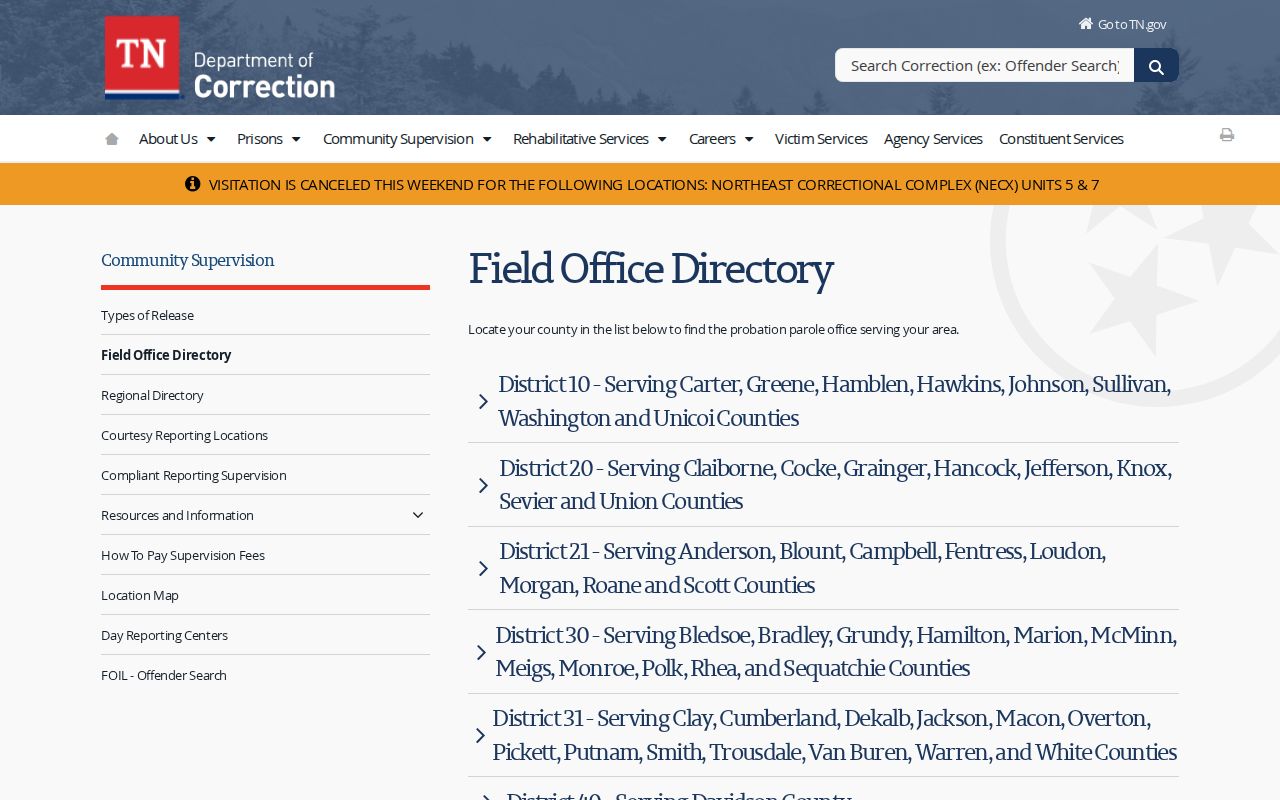
The directory gives Fayette residents a direct Somerville contact instead of routing each supervision question to Nashville.
Note: FOIL shows public status, while the field office handles operational follow-up within its disclosure rules.
Fayette Release Proof With ID
A supervision record answers what follows release. It does not replace the release record itself. The Fayette County Sheriff jail page offers an unusually clear correction path: proof of incarceration may be obtained in person or by mail after valid identification is presented. The published document contains the name used at arrest, booking number, arrest date, and release information.
Those fields help tie a supervision status to the correct custody episode. The arrest name can resolve an alias. The booking number separates one admission from earlier cases. Release information can confirm the end of local jail custody. The sheriff does not define every field within that phrase, so a requester should ask if date, time, authority, or transfer destination is maintained and public. The office may disclose, redact, deny, or state that a field is not kept.
Pair that local proof with FOIL when the person moved into TDOC custody or supervision. If the person left the Fayette jail for TDOC, the jail roster may lose the name while FOIL shows incarceration. That is a transfer, not community release. If FOIL shows parole or probation, review the release document and judgment to learn how the status began.
Fayette Supervision Violations and Warrants
Conditions are the rules attached to community supervision. A violation is an allegation that one or more rules were not followed. It can lead to investigation, a warrant, a hearing, changed terms, reinstatement, or revocation. Revocation means supervision is withdrawn and custody may resume. None of those outcomes should be inferred from an old status alone.
Fayette publishes a county Zuercher warrants route. It answers whether county-published warrant information appears. It is not a statewide TDOC absconder list, and a warrant entry does not show where the person is now. Reconcile a county warrant with FOIL, TDOC Community Supervision, Board records, the court, and the agency responsible for the warrant.
The source capture below preserves that distinction. The Fayette County warrants portal concerns warrant data rather than parole status.
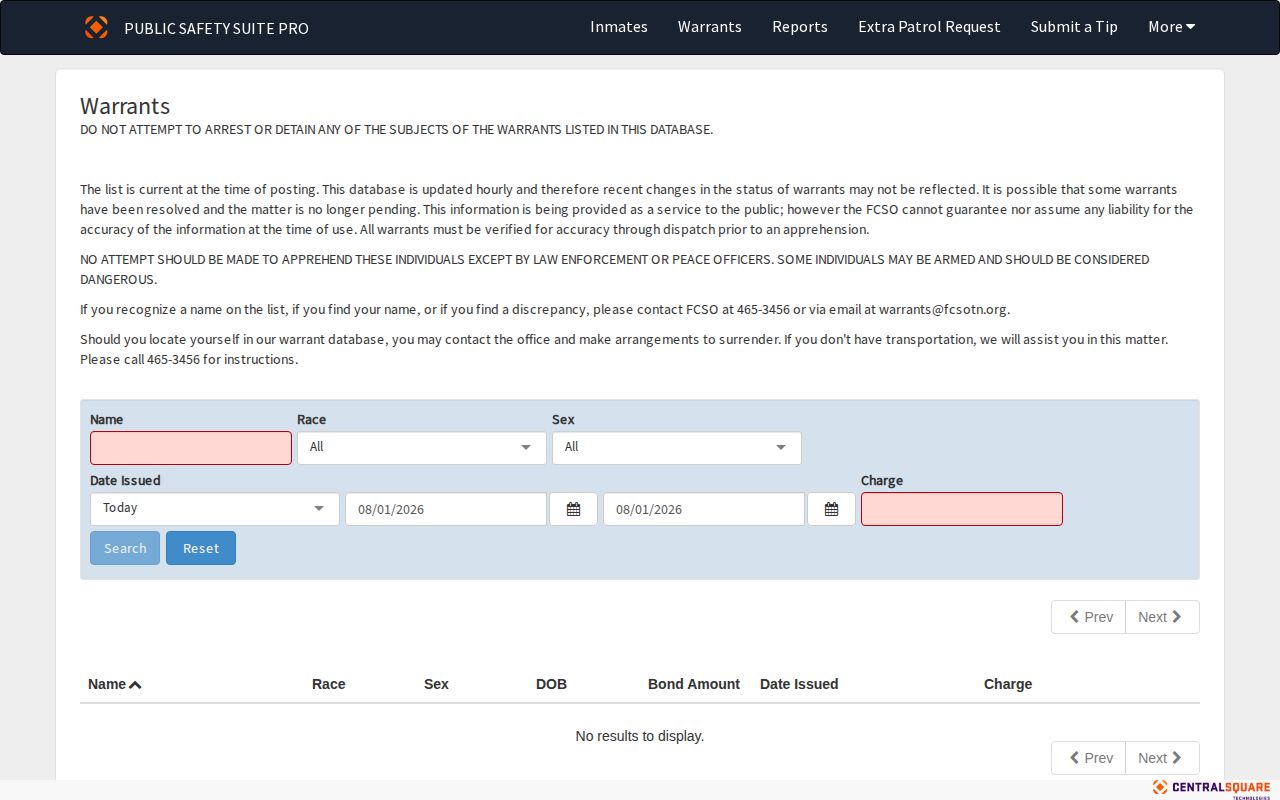
A name on that route requires case-specific verification. A missing name does not prove that supervision is active, complete, or free of another warrant.
Do not merge records: county warrant status, parole absconder status, physical custody, and post-release supervision are separate facts.
Fayette Parole Decisions Versus Release
The Tennessee Board of Parole hearing division conducts hearings at state prisons, county jails, and other locations for eligible people. Hearing officers make recommendations. Board members may adopt, change, or reject them. The Board says hearing schedules are updated weekly on Monday, or Tuesday after a Monday holiday, and current schedules are requested at BD.HearingSchedules@tn.gov.
Schedule fields can include TOMIS ID, name, hearing type, date, and facility. A schedule is only notice of planned consideration. It is not a decision. Likewise, a favorable recommendation is not a final Board action, and a final grant does not prove that release processing has ended. TDOC must still approve the release plan.
Hearing types also matter. A final revocation hearing may revoke or reinstate supervision. A rescission may undo a grant near the release stage. A custodial hearing can concern movement from one sentence to another. Report the actual term used in the record rather than converting each hearing into a release event.
The Board image documents the official schedule instructions and hearing context. Consult the current hearing-division page before relying on a date.
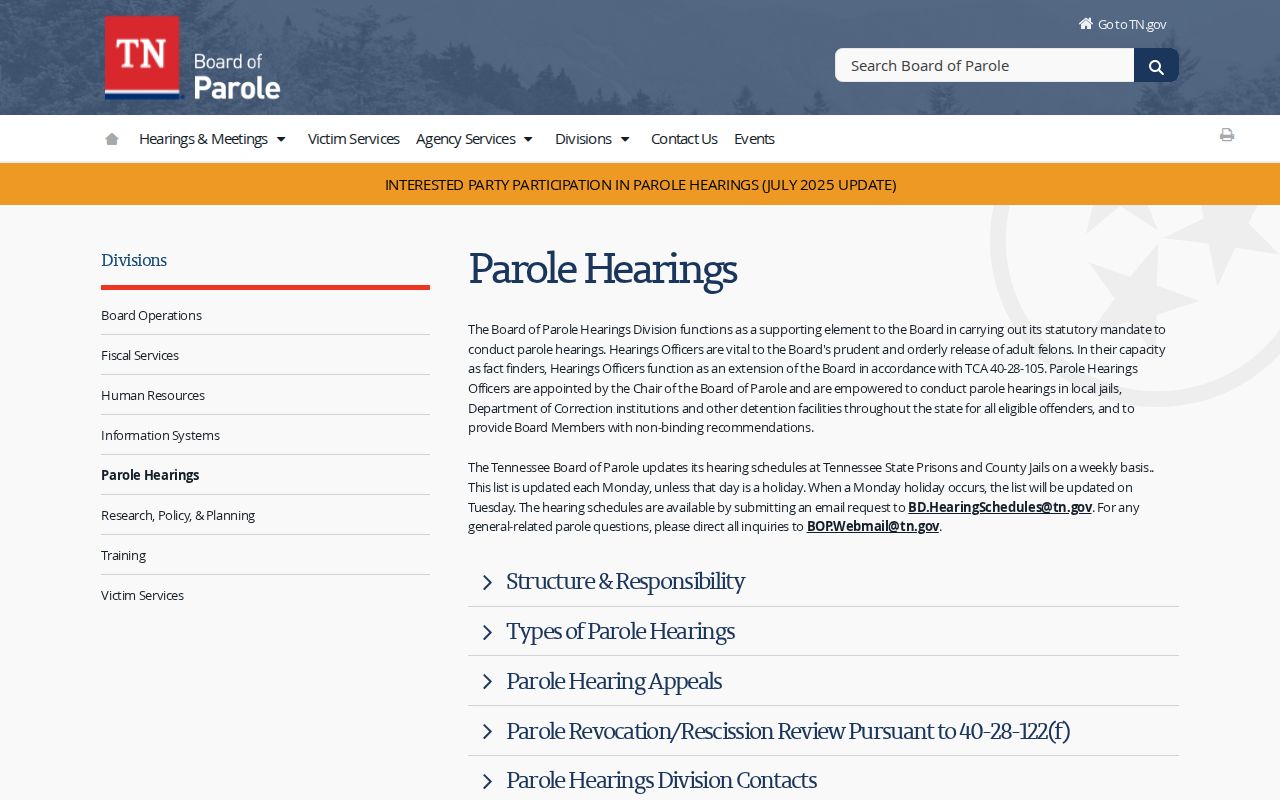
The weekly cadence explains why a saved schedule should always be checked again. General Board inquiries may go to BOP.Webmail@tn.gov or (615) 741-1150.
Note: A hearing date marks review, not a promise of Fayette County release or the start of parole.
Fayette Reentry Supervision Types
Tennessee has supervision routes beyond standard parole and probation. Determinate release is a statutory probation path under Tenn. Code Ann. § 40-35-501 for certain felony terms of at least one year but no more than two years after at least 30 percent is served, subject to TDOC's stated notice and objection process. It is not a rule for every Fayette sentence.
Mandatory reentry supervision under Tenn. Code Ann. § 40-35-506 applies within its eligibility rules to felony offenses committed on or after July 1, 2021. TDOC describes a route in which the last year may be served in the community when one year or less remains and parole eligibility terms are met. After a revocation return, the described route requires at least six months served. Some people not released for the last year may receive one year of service-focused supervision after sentence expiration.
These categories show why the words on the record matter. "Sentence expired" does not always mean that TDOC contact has ended. "Probation" does not show a prison release. "Parole eligible" is not "paroled." Match the FOIL status to the judgment, statutory route, and later order or discharge.
How Fayette Supervision Ends
Post-release supervision ends through the sentence, Board or court action, and TDOC discharge process. It does not end merely because a web record changes or stops appearing. When the end date matters, ask for the discharge or termination record. The original judgment, later modification, revocation record, and termination order form one timeline.
For parole, check the governing sentence and TDOC discharge record. For probation, start with the sentencing court and ask for later satisfaction or termination orders. If a violation occurred, include the revocation or reinstatement record so the sequence is clear. A certified agency response is the best proof when a formal record is needed.
Tennessee's public-record framework applies to existing agency records, subject to exceptions. It does not require staff to calculate a new end date or answer a broad legal question. A narrow request naming the person, identifier, case, approximate dates, and existing discharge document gives the custodian a clear target.