
No Fayette 72-Hour Release Feed
No official Fayette County three-day release view was found as of August 1, 2026. The sheriff's public jail source links to CentralSquare/Zuercher as Current Inmates. It does not expose a verified Released, Recent Releases, or 72 Hours control. There is no county-published window definition, release-field set, update cadence, archive term, or official mobile app that can be used as a substitute.
A 72-hour list usually answers a broad roster question: who left during the last three days? Fayette's sources instead support person-by-person verification. That difference matters. Three snapshots of a live roster do not become an official release feed, and a name seen on Monday but absent on Thursday does not establish when or why custody ended.
Important: Fayette County publishes no official 72-hour release list, so use the jail's release record for each person.
The sheriff capture documents the local source and its published record route. Check the official Fayette County jail page for current contacts and wording.

The page separates Current Inmates from proof of incarceration with release information, which is the useful three-day evidence.
Build a Fayette Three-Day Timeline
A reliable three-day check starts with identifiers, not a homemade list. Record the full arrest name, booking number, approximate arrest date, and the three-day interval at issue. If a relative last spoke with the person on one day and the roster changed later, keep both times as leads. Neither fixes the release moment.
- Check Current Inmates once for present Fayette custody and record the date and time of that check.
- Call Jail Booking at (901) 465-5247. Ask whether the person left Fayette custody during the interval and whether the outcome was community release or transfer.
- Request the sheriff's proof of incarceration with release information in person or by mail after presenting the valid identification it requires.
- Ask the Fayette Circuit and General Sessions clerk for the docket, bond or release order, judgment, sentence, and later orders during the same date range.
- Check TDOC FOIL, VINE, or the appropriate federal or immigration source only if the custody path makes that system relevant.
Keep the sources in event order. Roster disappearance is a clue. A court order provides legal authority. The jail or DOC release record documents the custody event. A later supervision record shows what followed. That sequence prevents a planned release, favorable order, transfer, and completed community release from being treated as the same fact.
For a narrower check confined to today, use the Fayette County 24-hour release process. The three-day method is better when the possible change crosses dates or a weekend.
Fayette 72-Hour Release Fields
Since Fayette maintains no published 72-hour feed, no official three-day field inventory exists. The sheriff does identify four parts of its proof-of-incarceration record: arrest name, booking number, arrest date, and release information. Build a date-range request around those known fields, then ask whether more detail exists. Do not promise that every requested item will be produced.
| Timeline field | How it supports the three-day check |
|---|---|
| Name at arrest | Matches the identity used in the Fayette booking system |
| Booking number | Links the inquiry to one custody episode rather than all cases |
| Arrest date | Anchors the start of the local episode |
| Release information | Published sheriff field confirming that the record contains release data |
| Release date or time, if maintained | Places the end of custody within or outside the requested 72-hour interval |
| Release type or destination, if public | Distinguishes entry into the community from transfer to another custodian |
A requester may name the booking sheet and jail custody log, and ask for admission and release date or time, releasing authority, transfer destination, court or bond identifier, and booking photograph. The custodian may redact protected details or report that an item is not maintained. The word "release information" should not be expanded beyond what the produced record actually contains.
Note: Ask for an existing record covering the interval, not for staff to create a new 72-hour list.
Fayette Weekend Release Checks
The wider period helps when Friday, Saturday, Sunday, a holiday, and the next business day may all affect when a caller can obtain records. Yet Fayette County publishes no weekend or holiday release schedule. It also gives no standard gate-processing time. The absence of published office access over part of a three-day window does not prove that jail releases stop.
The sheriff says bonds are set throughout the day. When applicable, a booking after 8:00 p.m. may have bond set the next day. It also says cash bonds within an unstated limit may be paid at the front-lobby kiosk Monday through Friday from 8:30 a.m. to 4:30 p.m. Those are bond mechanics. They are not a release-hours schedule, and they do not state when final identity, hold, property, and paperwork checks will finish.
When the possible release crosses a weekend, note the date of the court event, bond action, roster check, call to Booking, and issued release record. A court order may precede actual exit. Another warrant or detainer can also prevent entry into the community. Call Booking for the individual case rather than assigning the event to a date from a general assumption.
Weekend caution: the weekday bond-kiosk hours do not define when Fayette County Jail can complete a release.
Fayette Roster Changes Need Proof
The official portal's label, Current Inmates, is an editorial boundary. It can support a positive statement that a matching person appeared in current local custody when checked. It cannot supply a three-day release roster after records disappear. The sheriff does not publish the portal's refresh rate or post-removal retention.
Review the live Fayette current-inmate portal for its current scope rather than relying on a cached copy.
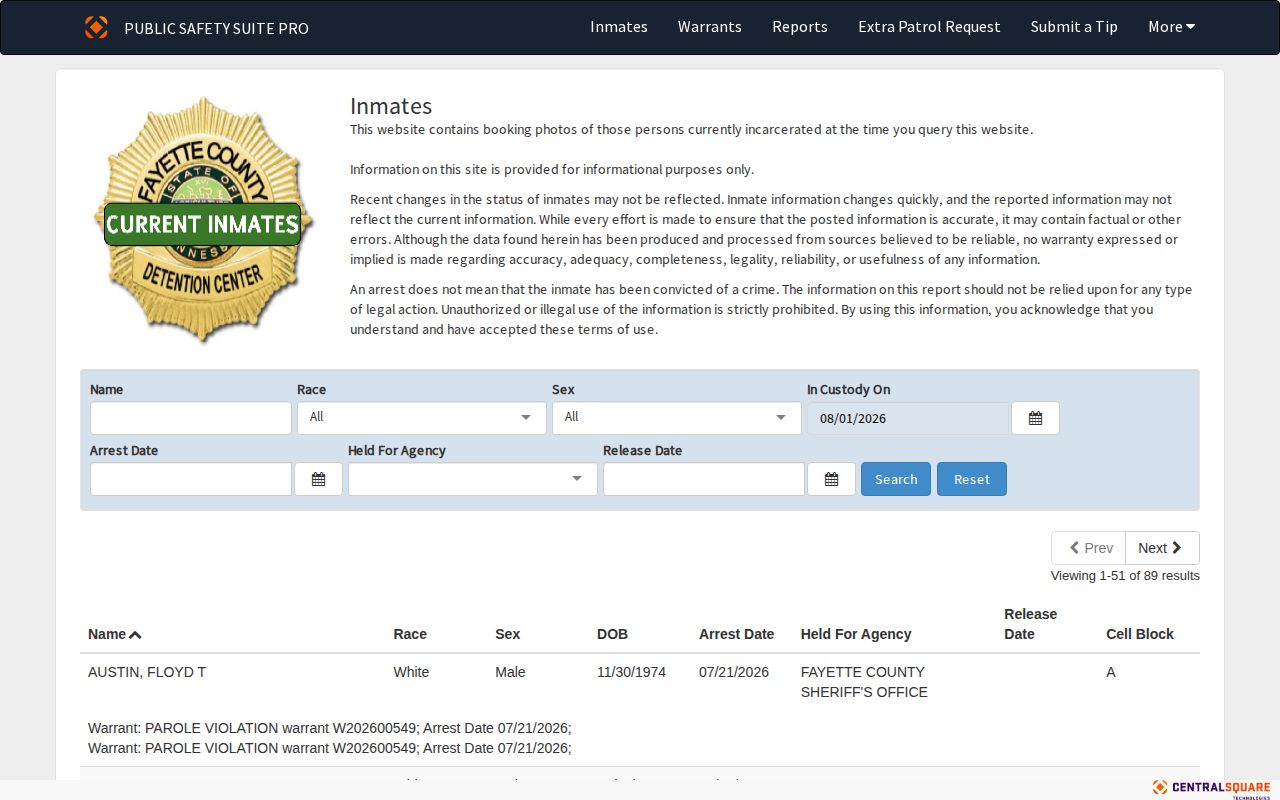
The capture shows why a removed name must be followed by an affirmative jail record rather than entered into a self-made release list.
A roster change can mean bond release, court-ordered release, completion of time, transfer to TDOC, movement to another county, federal or immigration custody, a spelling correction, or another data event. Death is also a possible cause of removal and must never be labeled release. Ask the jail for release type and destination if those fields are maintained and public.
The Fayette County Public Records Commission handles disposition under retention schedules, including possible archive transfer or destruction. No fixed online duration is promised. For an older event, ask where the record moved instead of assuming it stayed online for three days, thirty days, or forever.
Match Fayette Court and Release Records
The jail and Fayette Circuit and General Sessions clerk are both at 705 Justice Drive, but they preserve different evidence. The sheriff's record documents the custody interval. The court file documents legal authority and case disposition. Keeping those roles separate produces a much sounder three-day timeline.
The clerk may hold a docket sheet, charging document, arrest warrant, bond or release order, judgment, sentencing order, time-served credit, probation or revocation order, and a later termination order. No verified public name-based Fayette trial-court search was found. Contact the clerk at (901) 465-5205 during its published Monday through Friday hours of 8:30 a.m. to 4:30 p.m. Ask whether the matter remained in General Sessions or moved to Circuit.
A judicial release order is strong evidence that release was authorized. It may not state when jail staff finished the physical release. Another warrant, sentence, or receiving agency could also keep the person in custody. Pair the order with the jail release record. For a detailed named-person path across systems, the Fayette County release-record search sets out the broader sequence.
Trace Fayette Transfers After Departure
Departure from the Fayette jail does not always mean release to the community. If Booking reports transfer to TDOC or if a felony sentence makes state custody plausible, use TDOC FOIL. It covers felony offenders currently or formerly in TDOC custody or supervision. An incarcerated status can show that the person remains confined after leaving Fayette. Parole or probation describes community supervision. Inactive status and release information may document an older state event.
Tennessee VINE can provide a supplying agency's status and, when offered, notifications for a specific person. Fayette jail participation must be confirmed from the live record. A released or out-of-custody result is an alert-system status, not a certified county release record. A missing VINE result is also inconclusive.
Use the BOP Inmate Locator only for federal BOP custody. Use the ICE detainee locator only to test current immigration detention. Neither is a Fayette jail release feed. US Marshals custody may require the actual holding facility, federal court docket, counsel, or Western District contact because there is no comparable public historical USMS locator.
| Possible outcome | Next record source |
|---|---|
| Community release from Fayette Jail | Sheriff release information plus the court order |
| Transfer to Tennessee felony custody | TDOC FOIL and TDOC records |
| Federal BOP custody | BOP locator and federal court record |
| Current immigration detention | ICE locator and case-specific agency contact |
| Community supervision | FOIL, court judgment, and the assigned TDOC field office |
This routing turns a three-day gap into a documented custody trail. It also prevents a transfer from being counted as a community release.
Note: Search only the custody system supported by the facts; county, state, federal, and immigration records are not interchangeable.
Request Fayette Three-Day Release Records
The Tennessee Public Records Act concerns existing government records. It does not require the sheriff to compile a custom 72-hour list that the office does not maintain. A useful request asks whether an existing release log or report covers the stated dates and, if not, seeks the individual proof-of-incarceration and release records for identified people.
Under Tenn. Code Ann. § 10-7-503, a custodian receiving a written request must respond promptly. If the record cannot be produced promptly, the custodian has up to seven business days to deny with a legal basis, produce the record, or provide an estimated production time. That is a response framework, not a promise that all records arrive within seven business days. Tennessee citizenship can matter to the statutory inspection right.
Inspection is generally free unless law permits a charge. Copies and labor may cost money under an adopted policy. Fayette publishes no special release-record fee or turnaround. Ask for electronic delivery and a written estimate before duplication. If part of a record is protected, request the segregable public portions. Keep the dated request, proof of delivery, response, invoice, and files together with the three-day timeline.